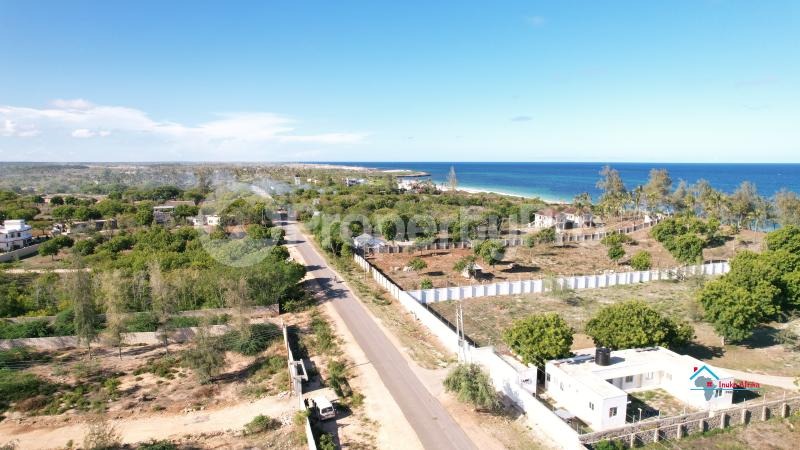
Real Estate Market Research & Investor Outlook — 2026
The broader Kilifi market has experienced significant appreciation.
Data from the Hass Consult Coastal Land Price Index, reported in 2026, indicates that land prices in Kilifi Town increased by approximately 40.1% over five years, reaching an average of about KSh 26.18 million per acre by the end of 2025. The market also recorded approximately 8.8% year-on-year growth.
However, Bofa should not be treated as a single uniform land market. Prices vary substantially according to
* Distance from the beach
* Beach frontage and ocean views
* Road accessibility
* Title and ownership structure
* Availability of water and electricity
* Plot size
* Development potential
* Proximity to established hospitality facilities
* Ability to subdivide or develop the property
Current listings illustrate this variation. Examples include a 0.5-acre third-row parcel advertised at approximately KSh 7 million, a one-acre third-row parcel at approximately KSh 11–12 million, and beachfront/near-beach parcels advertised at approximately KSh 15 million to KSh 40 million+ per acre.
Consequently, the investment opportunity in Bofa is not simply the expectation that land prices will continue rising rapidly. The stronger investment proposition is the combination of location, long-term capital appreciation and carefully selected development opportunities.
1. Market Overview
Bofa benefits from the broader transformation of Kenya's coastal property market.
Recent coastal property research indicates that demand is increasingly being generated not only by conventional tourism but also by diaspora buyers, retirees, remote workers, lifestyle migrants and people seeking second homes.
This is significant for Bofa because coastal land has a scarcity characteristic: prime beach-adjacent land cannot be expanded indefinitely.
The Hass Consult index reported that the most valuable coastal land tends to be concentrated within approximately one kilometre of the beachfront.
Bofa therefore benefits from a structural advantage: investors are acquiring not simply land, but access to a scarce coastal location.
2. Current Bofa Land Market
Available market listings demonstrate a wide pricing spectrum.
These figures should be treated as market asking-price indicators rather than independently verified transaction values.
For example, a February 2026 listing advertised 10 acres of beachfront Bofa land at KSh 15 million per acre, while other current listings advertise one-acre Bofa properties at KSh 35 million and KSh 40 million per acre.
This demonstrates that frontage and exact location can create very large price differences within the same general Bofa market.
3. What Is Driving Demand?
3.1 Coastal Lifestyle Migration
One of the most important changes in the coastal property market is the growth of lifestyle-driven demand.
Research reported in 2026 identifies retirees, remote workers, diaspora investors and long-stay visitors as increasingly important buyers of coastal property.
For Bofa, this creates demand beyond conventional holiday accommodation.
Potential buyers may include:
* Kenyan diaspora
* Nairobi-based professionals
* Retirees
* Entrepreneurs
* Hospitality investors
* Holiday-home buyers
* Property developers
* Land-bank investors
This diversification of demand can make the market less dependent on a single tourism cycle.
4. Tourism and Hospitality Potential
Bofa's strongest development opportunity is its proximity to the Indian Ocean.
Beachfront and near-beach land can potentially support:
* Boutique hotels
* Holiday villas
* Serviced apartments
* Private holiday homes
* Eco-tourism accommodation
* Restaurants and leisure facilities
* Wellness and retreat facilities
* Small hospitality developments
However, investors should distinguish development potential from guaranteed rental income.
A high land price does not automatically translate into high rental yields.
For example, purchasing a parcel at a premium price and developing an Airbnb or holiday-rental property may produce weaker returns if construction costs, management costs, utilities, maintenance and occupancy do not support the acquisition price.
5. Capital Appreciation Outlook
The broader evidence supports the existence of strong historical appreciation in Kilifi.
Hass Consult's coastal data places Kilifi Town's five-year land-price growth at approximately 40.1% between Q4 2020 and Q4 2025, with the average price reaching approximately KSh 26.18 million per acre.
This provides evidence of strong historical market growth.
However, investors should not assume that the same percentage increase will automatically repeat over the next five years.
The market may transition from rapid appreciation toward a more selective phase in which properties with:
* better access,
* clear titles,
* superior beach proximity,
* reliable utilities,
* development approvals,
* attractive views,
* established surrounding development
perform differently from less-serviced properties.
6. The Emerging Price Segmentation
Bofa is increasingly becoming a segmented market rather than one where every parcel appreciates equally.
Segment A — Prime Beachfront
These are properties with direct beach/ocean frontage.
Potential investor profile:
* Luxury residential
* Boutique hospitality
* High-end holiday villas
* Resort development
* Long-term land banking
This segment commands the largest premiums.
Current listings show advertised prices ranging from approximately KSh 15 million per acre to KSh 40 million or more, depending on the property and exact positioning.
Segment B — First/Second Row
These properties may offer proximity to the beach without direct frontage.
Their attractiveness depends heavily on:
* Beach access
* Road quality
* Ocean views
* Surrounding developments
* Utilities
* Security
* Plot configuration
This segment may offer a balance between acquisition cost and development potential.
Segment C — Third Row and Inland
Third-row properties can provide a lower entry point.
One current listing, for example, advertises one acre approximately 500 metres from public beach access at KSh 11 million, while another advertises a 0.5-acre third-row property at KSh 7 million.
This segment could be particularly relevant for investors targeting:
* Residential development
* Holiday homes
* Smaller villas
* Affordable coastal accommodation
* Long-term land banking
7. Key Investment Opportunities
Opportunity 1: Long-Term Land Banking
An investor who acquires appropriately priced land with strong documentation and good access could benefit from long-term appreciation.
The strongest land-banking proposition is likely to involve properties where the current price still reflects the surrounding area's development stage rather than fully pricing in future development.
However, land banking should be approached with a sufficiently long investment horizon.
Opportunity 2: Holiday Homes and Villas
Bofa's coastal environment creates potential for villas designed for:
* Weekend visitors
* Nairobi residents
* Diaspora families
* Long-stay visitors
* Holiday rentals
The investment case becomes stronger when the acquisition cost remains proportionate to the expected development and operating income.
Opportunity 3: Boutique Hospitality
Larger parcels with beach access may be suitable for boutique hospitality projects.
A developer could potentially create a smaller, differentiated coastal property rather than compete directly with large hotels.
Potential concepts include:
Boutique resort + restaurant + villas
or
Private luxury villas + managed holiday rentals
or
Eco-conscious coastal retreat
Opportunity 4: Subdivision and Resale
Large parcels may create an opportunity for subdivision into smaller plots.
A current Bofa listing, for example, advertises 50 acres of beachfront property specifically highlighting subdivision and resale as one possible investment strategy.
However, subdivision economics should be calculated after accounting for:
* Acquisition cost
* Surveying
* Planning approvals
* Infrastructure
* Roads
* Drainage
* Utilities
* Legal costs
* Marketing
* Taxes and transaction expenses
The gross selling price of subdivided plots should therefore not be confused with the developer's net profit.
8. Key Risks Investors Should Consider
8.1 Speculative Pricing
Rapid appreciation can create a situation where sellers price land based on expectations of future growth rather than current economic fundamentals.
The critical question for an investor is therefore:
"What will generate the return on this property if land prices stop rising?"
If the answer is unclear, the investment requires additional scrutiny.
8.2 Rental Yield Risk
A property purchased at a very high land value may generate disappointing rental yields.
This is particularly relevant where an investor intends to rely on Airbnb or holiday rentals to recover the acquisition and construction costs.
The investment should therefore be assessed using realistic:
Purchase Price + Development Cost + Operating Costs + Financing Costs
against
Expected Annual Rental/Operating Income.
8.3 Liquidity Risk
Land is not as liquid as cash or publicly traded investments.
An investor who buys at an aggressive valuation may have to wait significantly longer to exit if the market slows.
This is particularly relevant to large parcels.
8.4 Infrastructure Risk
Infrastructure remains an important consideration in coastal markets.
Recent reporting on the Coast has identified water availability and title issues as factors that can affect land values and development potential.
Before purchasing, investors should establish:
* Water availability
* Electricity connection
* Road access
* Drainage
* Internet/mobile connectivity
* Waste management
* Beach access
* Development restrictions
9. Due-Diligence Requirements
Before committing capital to a Bofa property, investors should verify:
Ownership
* Official land search
* Original title
* Seller identity
* Ownership history
* Encumbrances
* Caveats
* Charges
* Succession issues where applicable
Physical Verification
* Survey beacons
* Actual acreage
* Boundary verification
* Road access
* Beach access
* Neighbouring developments
Infrastructure
* Electricity availability
* Water source
* Road condition
* Drainage
* Internet connectivity
Development
* Zoning
* Approved land use
* Building restrictions
* Environmental requirements
* County approvals
* Coastal/environmental regulations where applicable
Financial Analysis
* Comparable properties
* Acquisition price per acre
* Development cost
* Expected rental income
* Expected resale value
* Holding costs
* Exit strategy
10. Investor Return Scenarios
Rather than promising a specific return, investors should evaluate Bofa under three broad scenarios.
Scenario A — Conservative
Land prices stabilize after a period of rapid growth.
The investor's return would depend primarily on the property's underlying utility and development potential.
Expected strategy: long-term holding or income-producing development.
Scenario B — Moderate Growth
Bofa continues attracting residential, tourism and lifestyle investment while infrastructure improves.
Under this scenario, well-located properties could benefit from continued capital appreciation alongside potential development income.
Scenario C — High Development Growth
Major infrastructure improvements, increased hospitality investment and stronger demand could accelerate development around prime coastal locations.
Under this scenario, strategically located land could experience significant appreciation.
However, this should be regarded as a scenario rather than a forecast.
11. What Investors Should Expect
Investors entering Bofa should expect a market characterized by strong location-driven demand but considerable variation between individual properties.
The investment proposition is likely to be strongest where the property combines:
Beach proximity + clear title + good access + utilities + realistic acquisition price + viable development potential.
Investors should be cautious about paying a premium solely because a property is described as "prime" or "beachfront."
The central investment question should instead be:
> Does the property's current price make economic sense based on its actual development potential, income-generating capacity and realistic future resale market?
12. Strategic Investment Positioning
For a professional investor, Bofa can be approached through three complementary strategies:
1. Land Banking
Acquire strategically located land and hold it for long-term appreciation.
2. Build-to-Income
Acquire land at a defensible valuation and develop villas, holiday accommodation or other income-generating assets.
3. Development & Subdivision
Acquire larger parcels, obtain the necessary approvals and infrastructure, subdivide where legally and economically appropriate, and sell individual plots.
The appropriate strategy will depend on the investor's capital, time horizon, risk tolerance and intended exit.
Conclusion
Bofa represents a developing coastal real-estate market with evidence of substantial historical appreciation and growing lifestyle, residential and tourism demand.
The broader Kilifi market recorded approximately 40.1% five-year land-price growth through 2025, while current Bofa listings demonstrate a substantial premium for beachfront and near-beach properties.
Nevertheless, the market should not be approached on the assumption that rapid appreciation will continue indefinitely.
The next phase of Bofa's property market is likely to place greater importance on quality of location, infrastructure, documentation, development potential and actual economic returns.
For investors, the opportunity is therefore not simply:
"Buy land because prices are rising."
It is:
"Acquire the right coastal asset at a price that remains defensible even if appreciation slows."
Investor Takeaway
Bofa's long-term investment story is built around coastal scarcity, lifestyle migration, tourism potential and Kilifi's expanding real-estate market. The principal opportunity lies in identifying properties whose underlying location and development economics justify their price—not simply following market speculation.